The Falcon 10X Unveiled: A New Era in Ultra-Long-Range Business Aviation
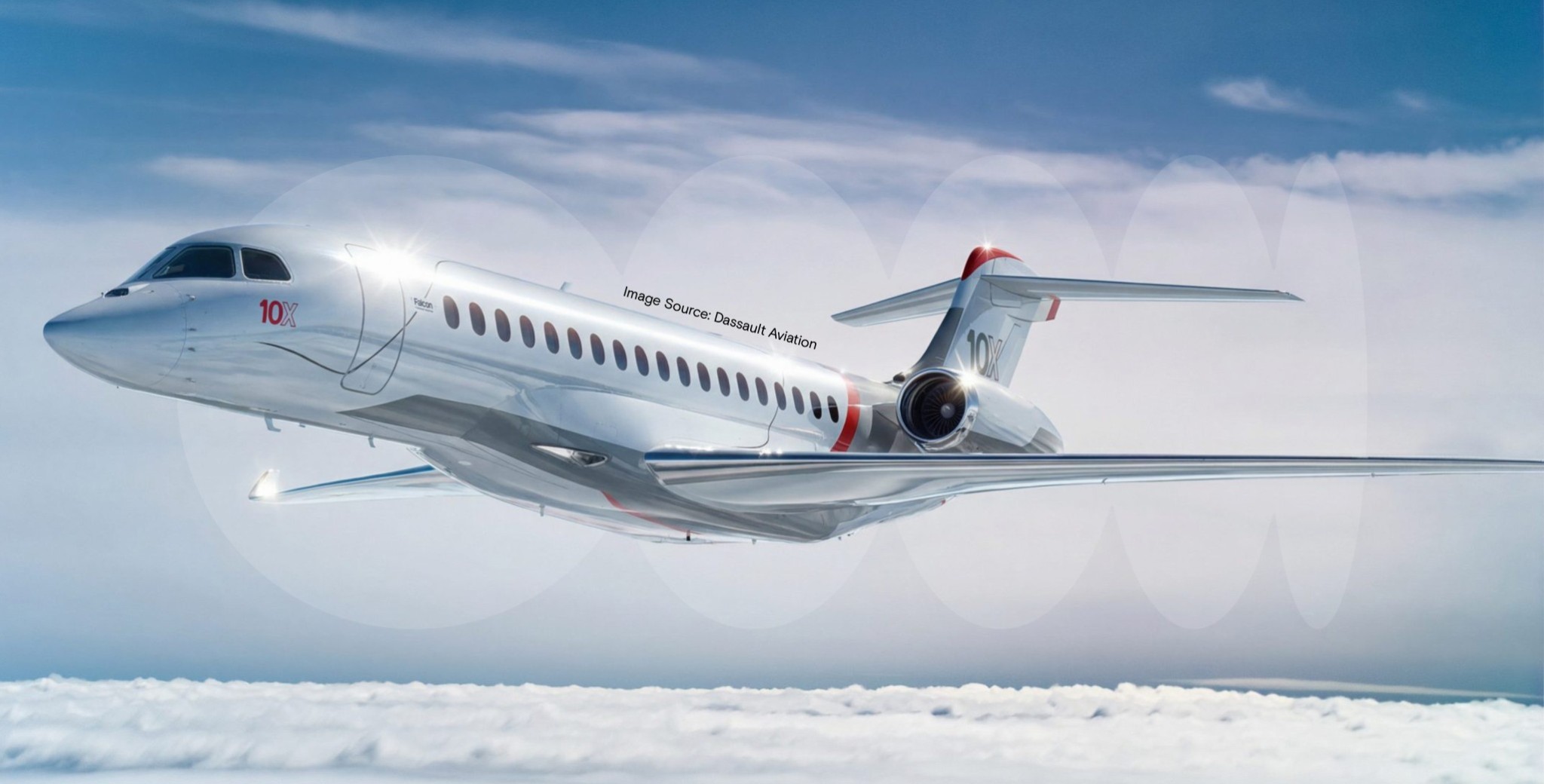
On March 10 in Bordeaux-Mérignac, France, Dassault Aviation unveiled the full-size prototype of its highly anticipated Falcon 10X. For the first time, customers and industry leaders were able to witness what will ultimately become the flagship of the Dassault Falcon lineup.
While prototype unveilings are always a milestone in any aircraft program, the Falcon 10X introduction carries broader implications. Dassault isn’t simply launching another long-range business jet; it’s making a clear statement about the future of the ultra-long-range category.
For owners and operators following developments in long-range aviation, the Falcon 10X represents more than a new aircraft. It signals a shift in priorities, emphasizing passenger experience, flexibility, and cabin comfort alongside the performance metrics that have historically defined the Dassault brand.
Moments like this also highlight why many aircraft owners rely on advisory firms such as jetAVIVA. Staying ahead of new aircraft programs, and understanding how they influence aircraft values, fleet planning, and acquisition timing, is essential in today’s rapidly evolving business aviation market.
A Clean-Sheet Flagship
The Falcon 10X is the most ambitious aircraft Dassault has ever developed. Designed from a true clean-sheet platform, it combines advanced aerodynamics, long-range capability, and the largest cabin cross-section in business aviation.
Key specifications include:
- Range: ~7,500 nautical miles
- Maximum cruise speed: Mach 0.925
- Cabin width: 9 ft 1 in
- Cabin height: 6 ft 8 in
- Cabin length: ~53 ft 10 in
- Engines: Rolls-Royce Pearl 10X turbofans
This performance allows the Falcon 10X to fly missions such as New York–Shanghai or Los Angeles–Sydney nonstop, placing it firmly in the top echelon of the ultra-long-range offerings.
Where the aircraft truly stands apart, however, is inside the cabin. With unprecedented width and volume, the 10X enables configurations rarely seen in business aviation, from private suites and full-size beds to stand-up showers and expansive living spaces.
Rethinking the Ultra-Long-Range Category
For the past decade, the ultra-long-range segment has largely been defined by aircraft like the Gulfstream G700, Gulfstream G800, Bombardier Global 7500, and the upcoming Global 8000.
Historically, competition in this category has centered on three primary metrics: speed, range, and cabin size.
The Falcon 10X suggests a subtle shift in that equation. Rather than pursuing incremental gains in cruise speed and pushing the envelope on range, Dassault appears focused on redefining the category around the passenger experience during the journey itself.
It’s also worth noting that very few ultra long-range business jets utilize the maximum range consistently. According to WingX data, roughly 86% of business jet missions are under 1,000 nautical miles, while flights exceeding 2,000 nm represent just 2.4% of activity.
In that context, the Falcon 10X’s expansive cabin becomes a defining advantage, offering exceptional space and comfort for both long-haul missions and everyday trips alike.
And from a visual standpoint, the aircraft’s size and proportions will give it a commanding presence on any ramp, something many owners appreciate.
Speed vs. Experience
One of the most interesting questions surrounding the Falcon 10X is how buyers will ultimately weigh speed versus cabin experience.
Aircraft such as the Gulfstream G700 and Bombardier Global 8000 emphasize high-speed cruise performance, with the Global 8000 targeting speeds approaching Mach 0.94. Industry headlines frequently highlight record-setting city-pair flights, reinforcing the importance of speed.
Ultra-long-range missions often exceed 12–15 hours. Over flights of that duration, the difference between Mach 0.925 and Mach 0.94 might save roughly 30–40 minutes of travel time. This may in fact be the most important variable to buyers in this category, however you’re still rocketing through the air in an aluminum tube for half a day or longer. While speed will always matter, many buyers increasingly recognize that comfort throughout the journey can be just as, if not more valuable.
Aircraft such as the Gulfstream G700 and Bombardier Global 8000 emphasize high-speed cruise performance, with the Global 8000 targeting speeds approaching Mach 0.94. Industry headlines frequently highlight record-setting city-pair flights, reinforcing the importance of speed.
But whether those records translate directly into buyer priorities is another question.
For some operators, particularly corporate flight departments flying frequent business missions, speed can provide meaningful efficiency gains over time.
However, many ultra-long-range flights today are flown by principals, families, or small executive groups traveling intercontinentally. In those cases, the aircraft effectively becomes a living space for half a day or more.
That changes the equation.
On a fourteen-hour flight, factors such as these begin to matter far more:
- True private living areas within the cabin
- Lower cabin altitude to reduce fatigue
- Improved soundproofing and cabin quietness
- Large windows that bring natural light into the cabin
- Flexible layouts for working, dining, and rest
For many passengers, those benefits may ultimately outweigh arriving thirty minutes earlier.
That’s the bet Dassault appears to be making.
How the Market May Respond
Based on current market dynamics, the Falcon 10X is likely to appeal to several distinct buyer profiles.
Owners currently flying aircraft such as the Falcon 7X, Falcon 8X, or earlier Global models may see the 10X as a natural next step, offering dramatically more cabin space while maintaining Dassault’s reputation for efficiency and airport accessibility.
Other buyers will be drawn to the aircraft’s focus on lifestyle. On ultra-long-range routes connecting regions such as the Middle East and North America or Asia and Europe, the cabin experience becomes central to the journey.
There is also a growing group of new entrants to business aviation, entrepreneurs, investors, and global business leaders, who prioritize design, comfort, and onboard experience just as much as raw performance. The Falcon 10X’s “flying penthouse” concept speaks directly to that audience.
Broader Market Implications
The introduction of a new flagship aircraft rarely affects only one model. Programs like the Falcon 10X often influence residual values, upgrade cycles, and future product strategies across the industry.
The 10X may even expand the definition of the ultra-long-range category itself. By introducing significantly greater cabin volume than existing aircraft, Dassault could effectively create a new tier within the segment, one defined less by speed and more by the quality of the onboard environment.
Why Clients Turn to jetAVIVA
Moments like the Falcon 10X unveiling demonstrate how quickly the business aviation market continues to evolve.
Although new aircraft programs take years to design and certify, announcements like this often spark immediate market interest and generate strong order backlogs. With most OEM delivery positions now stretching 18–24 months into the future, early awareness becomes critical for owners planning long-term fleet transitions.
At jetAVIVA, our approach is built around make-and-model specialization. Clients work with Sales Directors who focus deeply on specific aircraft families, including the Dassault Falcon line.
This expertise helps clients understand how aircraft like the Falcon 10X compare against competing models, determine when an upgrade might make sense, and anticipate how new aircraft introductions may influence the value of their current fleet.
When aircraft decisions involve tens of millions of dollars and long-term ownership horizons, having the right insight at the right time matters.
Looking Ahead
With the Falcon 10X now unveiled, the program moves one step closer to flight testing and eventual entry into service.
If the aircraft performs as expected, it could reshape expectations across the ultra-long-range segment.
The real question for the market may be simple:
Do buyers want to arrive marginally faster, or arrive having experienced the most comfortable cabin in business aviation?
Dassault appears confident many will choose the latter.
As the market evolves, jetAVIVA will continue providing clients with the insight, data, and expertise needed to navigate the future of business aviation.