Introducing the Gulfstream G300
Date
January 23, 2026Author
Michael Barber, Managing Director & VP, Sales OperationsExecutive Summary
Download NowRedefining the Super-Mid Segment
When Gulfstream introduced the G300, the intent was not to simply replace the G280, but to reset expectations in the super-mid segment by addressing practical limitations owners and flight departments have been navigating for years. The G300 is a clean-sheet evolution focused on usable space, mission flexibility, and operational efficiency, rather than chasing incremental spec improvements.
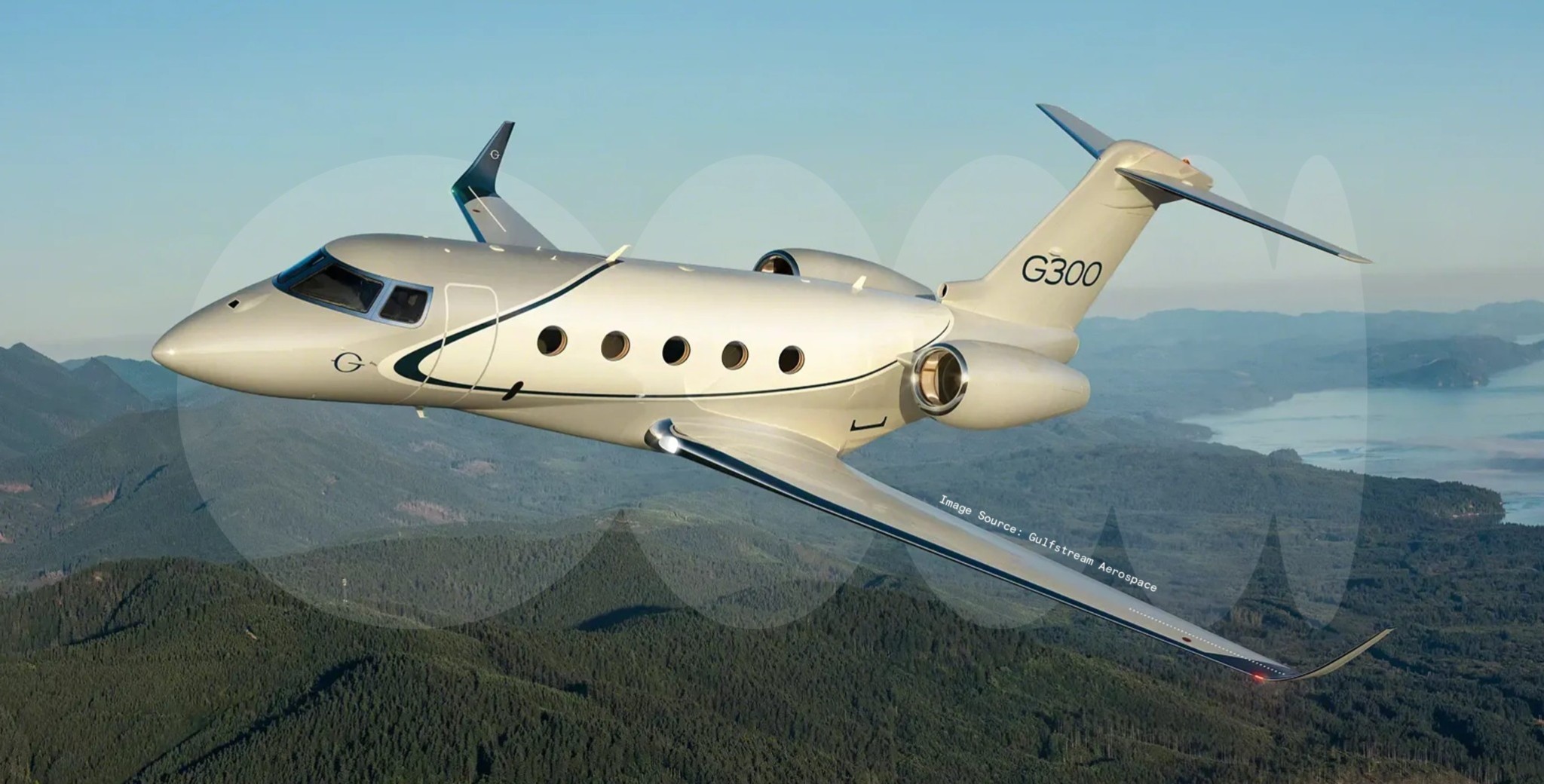
The most immediate change is the cabin. The G300 features a longer, more functional cabin than the G280, touting the longest cabin and largest baggage volume in its class. The addition of Gulfstream’s panoramic oval windows significantly increases natural light, reducing fatigue and making the cabin feel larger than its dimensions alone would suggest, an attribute Gulfstream owners consistently value when flying longer legs.
Range is another area where the G300 meaningfully shifts the conversation. With a published 3,600 nautical mile NBAA IFR range at Mach 0.80, the aircraft is optimized for the missions owners actually fly, not just marketing benchmarks. This allows consistent nonstop capability on demanding city pairs while maintaining realistic reserves. More importantly, the G300 offers flexibility between long-range cruise and higher-speed profiles, giving operators the ability to prioritize either efficiency or time savings depending on the mission at hand.
Up front, the G300 introduces Gulfstream’s Harmony Flight Deck into the super-mid category, and this is one of the most strategically important changes. Harmony is not just a new avionics suite; it is part of Gulfstream’s broader effort to standardize the cockpit philosophy across its whole fleet. For owners, especially those with flight departments including an array of Gulfstream models, this reduces training costs, improves pilot familiarity, and enhances safety through consistency. In contrast, several competitors continue to rely on more customized or fragmented avionics architectures across their models that create complexity as fleets grow or crews transition between aircraft.
Performance improvements also play a meaningful role in day-to-day usability. The G300 offers enhanced runway performance compared to the G280, expanding access to secondary airports, high-elevation fields, and shorter runways that are increasingly important for business aviation missions. This capability directly impacts scheduling flexibility and reduces the need for operational workarounds that owners historically encountered in earlier models.
What ultimately sets the G300 apart is not a single headline number, but the coherence of its design choices. Gulfstream clearly recognized that today’s super-mid buyers are less focused on owning the “largest” aircraft in the category and more focused on owning a more capable one for frequent and varied missions. By improving the cabin, delivering practical range, modernizing the flight deck, and enhancing airport access, the G300 establishes a new reference point the competition will have to respond to with substance, not just specifications. From a market perspective, it also signals how Gulfstream intends to protect residual values and long-term relevance in a segment that continues to evolve rapidly.