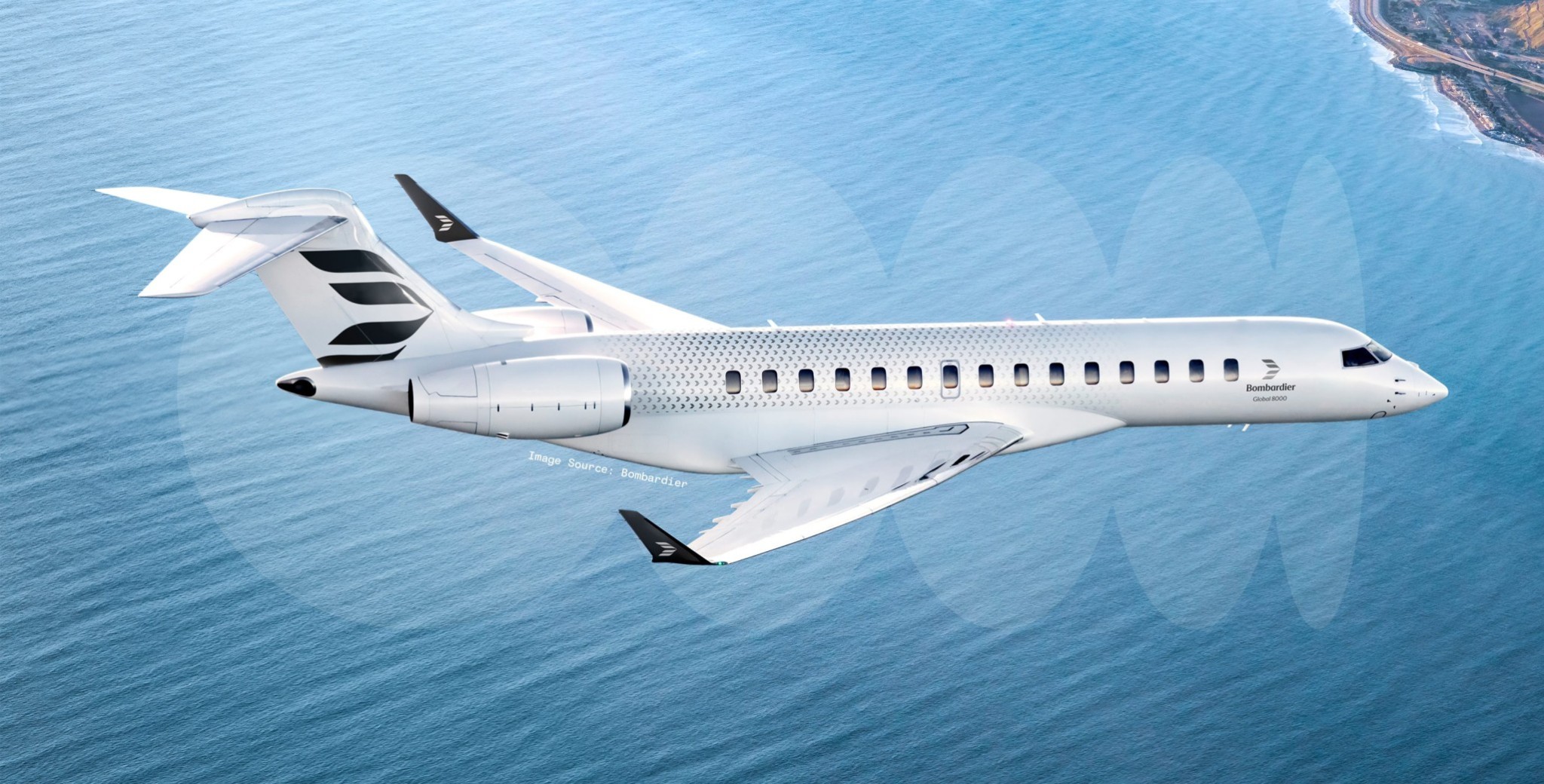
Introducing the Bombardier Global 8000
In business aviation, few moments reshape the landscape as clearly as the arrival of a new aircraft, and the recent delivery of the first Global 8000 marks one of those occasions. As Bombardier expands its flagship lineup, the Global 8000 introduces longer range, faster cruise speeds, and a modern cabin architecture that reflects the evolving expectations of ultra long range travelers. While the large cabin segment is filled with exceptional options from Gulfstream, Dassault, and Bombardier itself, the Global 8000 brings a fresh set of capabilities that distinguishes it within this competitive space. Now that it has officially entered service, understanding what the Global 8000 offers, how its refinements enhance long distance missions, and where it fits among today’s leading large cabin aircraft has become an important part of advising clients seeking the right solution for their travel needs.
A New Flagship Lands
The Global 8000 may be Bombardier’s new flagship, but it is not a clean-sheet design; instead, it is a refined evolution of the Global 7500. Bombardier enhanced the aircraft by making specific changes to the Global 7500 design. These improvements extend the range to 8000 nautical miles and raise the top speed to Mach .95, giving operators additional capability without departing from the proven strengths of the 7500’s platform.
The Global 7500 remains the foundation of the Global 8000’s development, and its role as the predecessor becomes even more significant with Bombardier’s plan to offer an upgrade path for existing owners. Through an available service bulletin, Global 7500 operators will have the option to convert their aircraft into the Global 8000, similar to the transition Gulfstream enabled between the G650 and G650ER. The upgrade costs three million dollars and will allow current 7500 owners to access the expanded capability set of the 8000 without purchasing a new aircraft, creating a unique bridge between the two models and extending the lifecycle value of the 7500 platform.
Performance Enhancements That Matter
Central to the Global 8000’s performance gains are targeted refinements to its wing design and the GE Passport engines, both aimed at extracting more capability from the aircraft’s existing fuel capacity. The Passport engines deliver the thrust required for ultra long range missions while operating with improved efficiency through the use of lightweight composite materials and refined aerodynamics. These updates support longer endurance and reduced fuel burn, while advanced acoustic engineering keeps cabin and community noise levels exceptionally low. Drawing on GE’s commercial aviation experience, the engine platform is designed for durability and consistency, reinforcing the Global 8000’s ability to perform reliably on the longest missions and shortest runways. According to Bombardier, together with the Smooth Flĕx Wing and its advanced leading-edge slats, these enhancements translate into improved runway performance and access to a significantly broader range of airports.
A Modern Cabin Designed for Long Hours
Onboard, the Global 8000 is tailored for passengers who spend long hours in the air and expect the cabin to work as an extension of their lifestyle or workspace. A low cabin altitude of 2,691 feet at cruise helps reduce fatigue, while a high-capacity air management system continuously refreshes the cabin and removes airborne particles, odors, and allergens. Seating builds on the Global 7500’s proven zero-gravity design, prioritizing comfort and posture over extended flight times. Circadian-based lighting adjusts throughout the journey to stay aligned with the destination, helping passengers arrive more rested and ready. High-speed connectivity options including Ka band, Starlink, and Gogo Galileo support uninterrupted communication worldwide, complemented by an updated entertainment environment that combines immersive, seat-focused audio with a large 4K display for a more personal and intuitive in-flight experience.
Positioning the Global 8000 Within the Competitive Landscape
The introduction of the Global 8000 reflects an evolution at the top of Bombardier’s product line rather than a departure from its broader strategy. The Global 5500 and 6500 remain central to the flagship lineup, continuing to serve operators with demanding long range missions, while the Global 7500 retains full factory support as the foundation from which the 8000 was developed. As emphasis naturally shifts toward the newest model, Bombardier’s approach reinforces continuity across the fleet, offering operators confidence that investments in existing platforms remain supported alongside the arrival of its most capable aircraft to date.
Within the ultra-long range cabin segment, the Global 8000 enters a competitive field long led in the United States by Gulfstream, whose G700 has earned a strong reputation as a go to ultra long range aircraft. With acquisition prices for both aircraft hovering around eighty million dollars, the comparison becomes one of capability and execution. The G700 offers a cruise speed of Mach 0.90, a range of up to 6,650 nautical miles, and a cabin altitude of approximately 2,840 feet at 41,000 feet. By contrast, the Global 8000 extends range to 8,000 nautical miles, increases top speed to Mach .95, and maintains a lower cabin altitude of 2,691 feet at cruise. Looking ahead, Dassault’s Falcon 10X is expected to further expand the segment in the coming years, adding another option in a category where incremental performance differences can have a meaningful impact on long distance missions.
Let’s Talk About Your Mission Needs
As the large cabin landscape continues to evolve, choosing the right aircraft begins with understanding how you fly. If you are evaluating ultra-long range options or considering where the Global 8000 fits within your plans, we are here to guide the conversation with clarity and expertise.